





Here you will find Bally Arcade / Astrocade articles and news from books, magazines, and trade papers.
/Arcadian Classified Ad (Kilobaud Computing)(September 1978)(Page 120)_tn.jpg) |
Arcadians Classified Ad (1978) Kilobaud Computing, September 1978, Page 120. A classified ad advertising the Arcadians newsletter. "Bally Owners and hopefuls are banding together for our mutual benefit to extract the maximum usefulness from this unit. Anyone interested is invited to write Bob Fabris, 3626 Morrie Dr., San Jose CA 95127 with a SASE"
|
/Arcadian Classified Ad (Kilobaud Computing)(July 1979)(Page 128)_tn.jpg) |
Arcadian Classified Ad (1979) Kilobaud Computing, July 1979, Page 128 A classified ad advertising the Arcadian newsletter. Bally Owners who subscribe to Arcadian know how to get four colors on the screen, do floating-point arithmetic and really get into making Tiny BASIC jump by poking it into the right places. Annual subscr., incl. 5 back issues, is $5 to Robert Fabris, 3626 Morrie Dr., San Jose CA 95127.
|
(Bob Fabris)_tn.jpg) |
Arcade Resurrection By Bob Fabris "Microcomputing" (Unpublished) Bob Fabris submitted this article in the winter of 1981 to "Microcomputing" magazine, but it was never published. Originally sold as a pure TV game accessory beginning in November, 1977, the Bally Arcade was upgraded to computer status by the introduction of a Basic cartridge in August, 1978. This ROM cartridge contained a version of Dr. Wang's Palo Alto Tiny Basic, restructured to utilize the onboard Z80 CPU and to accommodate three custom IC's that were included in the original unit to provide arcade color and sound features. An upgrade was promised that would provide a full-size keyboard, additional memory, and a new language called Z- GRASS. The author started to publish the ARCADIAN Newsletter when the Basic cartridge appeared, to support users with documentation and software since the factory was loathe to part with any data. By disassembling the Basic cartridge and on-board ROM, many interesting features were discovered and were published in the Newsletter for use of the subscribers.
|
(Electronic Games)(Page 11)_tn.jpg) |
"Astro Bits" "Astro Bits." Electronic Games, 1.1 (Aug. 1982): 11. Print. The biggest news from the company that took over the Bally Professional Arcade is that both manufacturer and machine have a new name-- again. Although research initially failed to turn up the fact, it seems that there is another Astrovision out there in the marketplace. To avoid problems with that concern, a distributor of X-rated videotapes, the videogame outfit has taken the name Astrocade for the machine and company itself. Two major licensing agreements soon bring star characters from other media into the world of videogaming. Astrocade has concluded agreements for games based on Conan and G.I. Joe. The two titles, both reworkings of programs already in development, should be available quite soon. (Conan is based on the Quest for the Orb game which the game-maker had previewed at 1982 industry shows). G.I. Joe, on the other hand, will be an enhanced version of a cassette title originally produced by one of the independent software suppliers for the Astrocade senior programmable videogame system.
|
(Mark Brownstein)_tn.jpg) |
"Astrocade Question: Sink or Swim?, The" By Mark Brownstein. "Video Games," 1, no. 7 (April 1983): 10, 12-13. Though it may seem Astrocade has exhausted its nine lives, the company, like some bedeviled cat, isn't dead yet. Nitron, a Silicon Valley semiconductor manufacturer, may very well come to the ailing game company's rescue. According to Nitron spokesman Rich Forte, "There's a very good chance that we will put up the money to revive Astrocade." Astrocade, which took over rights to the Bally Professional Arcade (aka, Astrocade) in 1980, filed a Chapter XI petition in Federal Court in Dec. '82. If the company is resurrected, expect to see several more Bally/Midway licensed titles. In the past, Astrocade's interpretations of arcade games have been extremely good. The Incredible Wizard is one of the best conversions ever of a coin-op game; Galactic Invasion is an excellent Galaxian; and Space Fortress even surpassed the original, Space Zap. If Astrocade's track record holds up, then it's probably fair to assume that Solar Fox, Omega Race, and The Adventures of Robby Roto would all be winners. Whether Astrocade ever gets the chance to prove this is now in the hands of investors and a Federal judge. Archiving note: This OCRed article was created from relatively low-res, 72-dpi, jpg, color scans. During testing, re-saving the low-res jpgs in the pdf made the document completely unreadable. For this reason, no pdf optimization was used when the document was OCred ("mixed raster content" was turned off). This makes the article's filesize much larger than normal (about 37MB, compared to just a few megabyte), but at least the article remains readable.
|
(Danny Goodman)(Radio Electronics)_tn.jpg)
|
"Astrocade's 'The Incredible Wizard' for Astrocade" By Danny Goodman "Radio Electronics," April 1983: 14, 20. This review of "The Incredible Wizard" is an excerpt from the "Videogames" column. Life for the Astrocade (formerly Bally Arcade) console and its owners has not been too easy of late. For one thing, there have always been pretty slim pickings when it came to cartridges. For another, the manufacturer's (Astrocade. Inc.'s) precarious financial situation, which has become common knowledge in these past few months, has put the future of the machine in doubt. [...] In any event, most of the cartridges that do exist are of high quality, owing largely to the vast graphics and sound resources of the Astrocade console electronics. One such cartridge is "The Incredible Wizard," Astrocade's home version of the mildly successful Midway arcade game, "The Wizard of Wor."
|
_tn.jpg) |
Astro Update "Astro Update" (Electronic Games, July 1982, Pg. 11) Here are the new titles scheduled for release in '82 from Astrovision for the former Bally Professional Arcade: "Munchie," a gobbler game that may or may not be released, pending talks with Atari (see Atari story elsewhere in Hot-line); "The Wizard," a home version of "Wizard of War" from the coin-op version's creator, Bob Ogdon; "Solar Conqueror," an exciting Asteroids-inspired contest with a number of its own unique features; "Cosmic Raiders," a sideways- scrolling shootout; "Quest for the Orb," a high adventure program; "Pirate's Chase;" "Coloring Book with Light Pen;" and "Music Maker."
|
_tn.jpg) |
"Astrovision Aiming At Bigger Piece Of Game Pie" Comsumer Electronics Monthly (March 1982, Page 94) Vice president of AstroVision, George Ray, gives an extremely upbeat company forecast up through 1990. There is some pretty far-out thinking going on here. Either George had NO clue about what was going on behind the scenes or he is straight-out lying. He seems sincere enough, so I think that the upcoming shake-up that moved the entire industry just wasn't foreseen by him or by anyone.
|
_tn.jpg) |
"Astrovision Plans Multi-Segment Marketing Thrust for New Zgrass-32 Computer System." By George Moses. 198x. This was found among the Bob Fabris Collection. It may never have been published-- and it certainly looks and reads more like marketing material than it does a true article. Perhaps this was a press release of some kind.
|
May 1982)(Arcade Alley column)_tn.jpg) |
"Astrovision's Rising Star" [Reviewed: "Bally Pin" and "Galactic Invasion"] By Bill Kunkel & Arnie Katz "Video," May 1982 ("Arcade Alley" column) If common sense had anything to do with it, the Bally Professional Arcade might have become the most popular home programmable game-playing system. The business world, however, seldom functions that way. Bally Pin (Astrovision/3005) waited in limbo for some time before seeing the light of day. Its year or more of obscurity proved undeserved. This is absolutely the best video-game pinball simulation ever offered for any programmable home system. It clearly shows Bally's expertise in the pinball area. It had to be first class all the way to maintain Bally's reputation, and is. Galactic Invasion (Astrovision/2011) brings the thrills of Galaxian to the Professional Arcade. In fact, the first edition of this cartridge actually read "Galaxian" when booted on the system.
|
|
"A Broker's Bubbly Ballyhoo for Bally" By Dan Dorfman "Daily News," April 29, 1982 This article was published about a year and a half after Bally Mfg. Co. sold the Bally Arcade to Astrovision. Yet, the company way still pursuing games... just not the same kind. Here is a look at what Bally was up to not long after they shed their only game console. Bally no longer is a single-facet company-- strictly a slot- machine maker (now only about 6% of revenues)-- but rather a rapidly growing leisure-time force catering to the entire family. He cites in particular Bally's acquisition of the Six Flags amusement parks-- an estimated $300 million business this year-- making it second only to Disney in this field. Add this to Bally's more than 350 Aladdin's Castle family amusement-arcade centers "and you give the company almost a motherhood image... that institutions may find easier to buy," says Koenig.
|
|
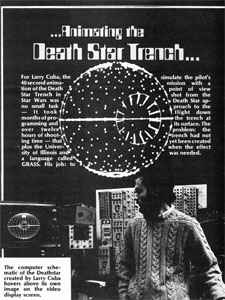
"Animating the Death Star Trench..." By Neesa Sweet "The Very Best of Fantastic Films: The Magazine of Imaginative Media." Special Edition #22, February 1981. Larry Cuba and Tom Defanti had both worked with ZGRASS for the unreleased Bally Add-Under. ZGRASS was based on the earlier GRASS programming language. GRASS was used to create animation for the original 1977 "Star War" movie. For Larry Cuba, the 40 second animation of the Death Star Trench in Star Wars was no small task-- it took months of programming and over twelve hours of shooting time-- that plus the University of Illinois and a language called GRASS. His job: to simulate the pilot's mission with a point of view shot from the Death Star approach to the flight down the trench at its surface. The problem: the trench had not yet been created when the effect was needed.
|
(june 1983)(300dpi)(color)_tn.jpg) |
Astrocade: One More Time
By Mark Brownstein. "Video Games," June 1983. This is an overview of the Bally Arcade/Astrocae system; this article is not a review of the hardware. It covers both the history and the current (at the time) situation. In 1983 this article would have been very helpful to Astrocade owners that were in the dark. It even mentions rare (released) hardware items like the Blue Ram expansion (which didn't get much mainstream press elsewhere). [In 1976] Jeff Fredrickson, of Dave Nutting & Associates, the design wing of Bally/Midway, is busily developing its own home game system that will be known as the Bally Professional Arcade. It will be designed to accept cartridges that load similarly to a cassette tape (and even look like them), while allowing owners to play games on a regular television set. It has at least six times as much game storage capacity as the Atari VCS, but won't be the success it should have been. Although initial orders were taken in September 1977, Bally wasn't ready to fulfill its orders for a few months. Those units were, on the whole, defective, with heat-sink problems being the major difficulty. A user would buy the unit, take it home, turn it on, and it would overheat, frying some of the sensitive components. The system would then have to be returned to the dealer and many of those first sales ended up being non-sales, with the defective units returned for refund, rather than being replaced by working units. It took some owners six or seven "trade-ins" before getting one that was reliable. This was enough to discourage most potential purchasers, and marked the system from the beginning.
|
/Astrocade (System Review)(Radio Electronics)(July 1982)_tn.jpg)
|
"Astrocade (System Review) By Danny Goodman "Radio-Electronics." July 1982 (vol. 53, no. 7). This Astrocade review is an excerpt from a special 23-page feature called "Video and Handheld Games: A buyer's guide to electronics games." The article also covers videogame history, Mattel Intellivision, the Magnavox Odyssey 2, the Astrocade, the Atari 2600 and 5200, Activision, and handheld and tabletop games. Few veteran video arcade goers can forget some of the great old games from the late 1970's; games like Gunfight, Sea Wolf (remember looking through the periscope), and 280 Zzzap. Those games were so much fun to play that you can still find them in many arcades, although you may have to look around a bit. You can now play them at home, too, if you own an Astrocade from Astrocade, Inc. All of that aside, the reason you buy any videogame is the games available. Having four games built into the machine is an advantage. Actually, two of them aren't games at all, but could be more accurately called "activities." Calculator, for example, is a "video" calculator that displays all of the figures entered and all of the operations performed, as well as their results. Although only 10 lines are displayed at any one time, it is possible to scroll up and down through up to 92 entry lines. Scribbling lets you use the built-in keypad and the hand controllers to create a wide variety of multi-colored patterns. Perhaps the most interesting feature in that activity is that it lets you create a random kaleidoscope of color and patterns on your TV set by simply entering "0" players when the "how many players" prompt appears. Those patterns and colors are simply amazing to watch.
|
|
"Astrocade Enters Video Space Wars" (No Author Mentioned) "Leisure Time Electronics," February 1982 Astrovision is about to fire its first salvo in the "video space wars" that are taking place between the various video game manufacturers. Flushed with what the company terms "the success of the 1981 commercial that helped sell out the company's entire production capacity of video games," the Columbus, OH-based concern is launching a $10 million TV advertising campaign. The campaign premiered during the recent WCES in Las Vegas. The commercial features a tiny man inside three of the forthcoming Astro Professional Arcade (nee Bally Professional Arcade) video games-- Coloring Book with Light Pen, The Wizard, and Munchie-- nearly getting "munched" in the process. The newest series of video games are being billed by the firm as "the first to combine commercial arcade coin-op realistic action with the intrigue of home computer 'adventure'-style games."
|
(Astrocade's Extended Play)_tn.jpg) |
"Astrocade's Extended Play" By Mark Brownstein "Video Games," March 1984 Over the last year we've reported quite a bit on Astrocade, this in spite of the fact that the firm went belly up more than a year ago. In a recent issue, we presented reviews of Astrocade games-- some of which were available before Astrocade's bankruptcy, and others which became available after the system's most recent demise. That article prompted a great deal of interest from "Video Games" readers. So first, in response to your letters, the attached sidebar lists many of the major manufacturers of Astrocade software. Since we last reported, L&M Software has come out with a new cartridge game-- Ms. Candyman. Mercifully, the game is a lot like Candy Man, with enough features to fully stand on its own.
|
|
"Astrocade Sues Commodore and Atari" By Barry Bayer "Infoworld," June 1982 Astrocade, a Columbus, Ohio, manufacturer of video games and microcomputers, announced the filing of a patent-infringement lawsuit against Atari and Commodore at the Consumer Electronics Show in Chicago. The suit, filed in U.S. District Court for the southern district of New York, claims that Atari and Commodore are using two patents licensed exclusively to Astrocade that deal with bitmapped graphics for video display. Bit-mapping aids in producing high-resolution graphics. The suit requests damages of an unspecified amount, plus the issuance of an injunction against the defendants prohibiting them from using patents number 4,296,930 and 4,301,503. Each patent was issued late last year to Jeffrey Frederiksen and assigned to Bally Manufacturing Company, which Astrocade claims licensed the patents exclusively to Astrocade.
|
(Danny Goodman)_tn.jpg) |
"Astrocade's Underground" By Danny Goodman "Joystik," September 1983: 18-21. This article is about how Astrocade users get along without support from Astrocade, Inc. In 1983, this was quite a lot of exposure for this console. The article begins: You can't really call the group an "underground," because it operates openly, almost vocally. But few of the millions of Atari, Mattel, Odyssey and Coleco players are aware that an entire cottage industry has grown around the highly rated, but rarely seen, Astrocade Professional Arcade system. To gain appreciation for the third-party support out there, consider that almost 400 individual programs are currently available for the Astrocade -- more than for the Atari 2600 and Mattel Intellivision combined. In conversations, correspondence and meetings with several members of the group, I found a common thread of intense dedication to keeping the Professional Arcade alive. Despite the up-and-down activities of the system's producers over the years, the Arcade guerrillas are keeping the faith.
|
|
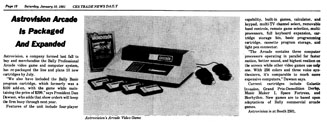
Astrovision Arcade is Packaged and Expanded CES Trade News Daily, Jan. 10, 1981 Astrocade has repackaged the line, added Bally BASIC and plans ten new cartridges. (1 page) |
_tn.jpg) |
Astrovision Shoots For The Stars "High Fidelity Trade News" (Circa 1982) The future plans of Astrovision, Inc.. (1 page) The full article, in text format, can be read here. |
| "Video Games," October 1982 | Atari Vs. Astrocade By R.H. Video Games, October 1982 A short news item that gives the reason why Munchie (the Astrocade Pac-Man clone) was never released. (1/4 Page) |
(1980)_tn.jpg)
|
"Bally Arcade Game / Computer" Possibly written by Bill Kunkel and Arnie Katz (under his pseudonym, Frank Laney Jr.) "Video" Magazine: (Probably an issue from 1980): 28-29. This is "Video Test 36" from the "Video Tests" column. We haven't figured out exactly what Bally calls this product-- some of the literature calls it the "Professional Arcade"; the rest refers to it as the "Bally Computer System." (Our box said "Professional Arcade.") That double name is a sign of its dual personality: the Bally is a video game you can turn into a full-fledged computer-- or a half-fledged one, if that's your pleasure. Bally's keyboard add-on isn't available yet, though. But it's just the third level of a three-level system. Level I is the video console shown here, a programmable video game with a built-in calculator keypad plus two hand controls and provision for two more. All by itself, it gives you three games to play plus its calculator function, and there are 28 more games and 6 educational programs now available on sixteen Videocade ROM cartridges. "Bally Arcade Game / Computer" - Text Format |
/Electronics Today (Nov 1978)_tn.jpg) |
"Bally Arcade: More Than Fun" By Graham M Wideman and Mark J Czerwinski. "Electronics Today," November 1978 This is an article from the November 1978 issue of Electronics Today, a Canadian electronics enthusiast magazine. The article covers the Bally Arcade. Although the page numbers are not consecutive in this scan, the article is complete (full page advertisements were removed). The article is notable because it assumes a basic level of technical knowledge and includes photographs of the internals. This article was originally scanned and posted by BOXPRESSED in January 2014 and posted to his blog on RetroAuction.com. The person that scanned it asked me to give credit to the blog if the article was posted on BallyAlley. The originally post said, "Hi friends. I recently acquired an old issue of Electronics Today (an electronics enthusiast magazine out of Canada) from 1978. Included is an article on the Bally Arcade, yet to be released in Canada at the time of the article's writing. I have scanned the article and uploaded it to my blog (link below). Enjoy!"
|
(Electronic Games)_tn.jpg) |
"Bally Pin" Review. (Excerpt from "Programmable Parade" column). "Electronic Games," May 1982: 70. By Arnie Katz and Bill Kunkel. Note that "Bally Pin" was later renamed "Astrocade Pinball." "Imagine a videogame version of pinball with all the color, action, and excitement of the real thing. It would offer two distinctive playfields, two sets of flippers, reset spin-paddle, thumper and back bumpers. [...] Bob Ogdon's design for this pinball simulation is so skillfully constructed that even those staunch videogame chauvinists who wouldn't be caught dead near a flipper machine will soon find themselves transfixed by the realistic play, vivid colors and inspired play mechanics."
|
/Bally Computer Uses Plain Language (Electronics)(Jan 18 1979)_tn.jpg) |
"Bally Computer Uses Plain Language" By, possibly, the editor. "Electronics," Jan 18, 1979. The article concentrates on what Bally showed at the CES show in Las Vegas. The article states, "Whereas many personal computers use some form of BASIC, Bally Corp. is coming out with a custom language [Z-GRASS] that uses words instead of letter-number combinations to make it seem friendlier." |
(Creative Computing)(Sept-Oct 1978)_tn.jpg) |
"Bally Professional Arcade By Karl Zinn "Creative Computing," 4, no. 5 (Sept-Oct 1978): 56-59. This article covers the Bally Arcade, not as a game playing console, but as an entry-level computer for use with BASIC. The only way that games are covered at all is using Bally BASIC to create games. There is a sample type-in BASIC program included called "Guess the Number."
|
(Oct 1977, Page 202)_tn.jpg)
|
Bally Introduces New Programmable Game Unit Byte, Oct. 1977 "The new Bally Professional Arcade home TV entertainment center is a well-engineered example of the new breed of programmable game modules which use microprocessors for logic and control functions." This short piece of news is available in text format, here. |
_tn.jpg)
|
Bally Professional Arcade from Astrovision, at CES booth 2501. Show Daily Arcade $299, ZGRASS-32 Keyboard $599, Complete System $898. "32K Computer. With the plug-in ZGRASS-32 keyboard, the Arcade becomes the easiest computer to use and the most powerful system available for creating graphics on the TV screen." |
(Hope Heymen)_tn.jpg)
|
"Cartridge Sales Make Game Market A 12-Month Season." By Hope Heymen Consumer Electronics, 8.5 (May 1980): 87-88. Print. This article details the growth of the games industry and that it chrihas grown large enough that games are no longer Christmas season items only; games can be sold year-round.
|
_tn.jpg)
|
Computer Programs in BASIC (Excerpt) By Paul Friedman Computer Programs in BASIC, 1981 This book is a listing of many programs written in BASIC that are available from different sources for various microcomputers. Two programs for the Bally Arcade are mentioned. They are "Guess The Number" (from "Creative Computing") and "Battlestar Galactica" (from "Kilobaud Microcomputing"). The front cover of the book and the two pages with the Bally-related information are all that have been scanned. Most of Bally-related excerpt is in text format here. |
(Feb 15 1979)(Page 10)_tn.jpg)
|
"Computer-Game Combinations Take Place Of Simple Games." By Tony Rud. MART. Feb 15 1979, Page 10. Bally and Mattel introduce modular systems which add on to basic game components. Combination computer-game systems introduced by Bally and Mattel showed the way the business is evolving, as personal computers pre-empted Convention Center space and attention once devoted solely to video games. |
(Feb 1979)_72_tn.jpg)
|
"Computers At CES: Dynamic, But Still Confused." By Hope Heyman. "Consumer Electronics," February 1979: 72-73. Programmable game makers muddied the waters by jumping into the field. And existing suppliers-- themselves now unsure of how to penetrate the mass market--have begun to frantically realign marketing plans after largely unsuccessful forays into department stores. In spite of the lack of a clearly defined audience or crystallized marketing strategy, however, the computer field at CES still exhibited the excitement of a dynamic industry. Bally added both a keyboard and a new language to its programmable, then promptly renamed it Bally Computer System. The language is GRAFIX, and is self-teaching, the firm says. The entire system now functions on three levels: as a video game, as a video game with Bally BASIC programming and as a computer system with a range of peripherals. |
(Videogaming Illustrated)_tn.jpg) |
"Conquering The Incredible Wizard." By Unknown. "Conquering: The Incredible Wizard." Videogaming Illustrated Dec. 1982: 24-26. This is an in-depth stategy guide for the "The Incredible Wizard" for the Bally Arcade/Astrocade.
|
(John Teets)(Chicago Sun-Times)_tn.jpg)
|
Home Computers Spawn 'User Groups.' By John Teets. Chicago Sun-Times. Circa 1981 or 1982. "A user [of the Bally Arcade] from Lake Villa, Ill., sent along several issues of the 'Arcadian,' a newsletter for an informal group of Bally owners on how it works, what they are doing with it and what they hope to accomplish. It is pretty impressive. His impassioned followup wasn't bad either, in the realm of unsolicited testimonials."
|
|
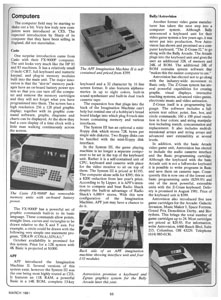
"International Winter Consumer Electronics Show" By David H. Ahl. "Creative Computing," March 1981: 52-70. This page is just an excerpt concerning the Bally Arcade/Astrocade. The complete article covers the International Winter Consumer Electronics Show, January 8-11, 1981.
|
_tn.jpg) |
Chip Set Marks Difference Between Arcade and Home Games By John C. Dvorak InfoWorld, May 12, 1982 Brief article talks about how using a chipset (in particular the DNA shipset) in conjunction with a CPU makes the graphics smoother. (1 page) A text version of this article is available here. |
(Electronic_Games)_tn.jpg) |
"Express Stop" User Letter Printed in Electronic Games Magazine, November 1982 Letter from Alfonzo Smith, Jr. (Cleveland, Ohio) asking what happened to the BASIC Express newsletter. The editor explains that the newsletter is no longer published and that an upcoming article concerning the Astrocade will be published in the January issue. (1 Pages, plus magazine cover) |
(jan 1983).jpg) |
Game Workout - Astrocade By Michael Blanchet Electronic Fun with Computers & Games, January 1983 A review of the Astrocade console. Includes some screenshots of unreleased games. Color article plus the cover of the magazine (3.9MB). A smaller (847K) B&W version (without the magazine cover) is also available for faster download here. (4 pages, plus cover) |
(Kilobaud_Computing)[Cover]_tn.jpg) |
Have a Ball with Bally By Richard Nitto KILOBAUD MICROCOMPUTING (November 1979): 142-144 A review of the Bally Arcade console. This review, unlike many reviews for this system, concentrates strongly on Bally BASIC, so much so that it nearly avoids the topic of the cartridge games altogether. There are numerous short examples of Bally BASIC syntax. This article also includes a type-in game called "Battlestar Galactica." This is also one of the few mainstream publications of this system aimed at a general audience. This scan was made from a bound copy of the magazine. It is nearly impossible to read the inner-column of the article because the binding was so tight that the inner column couldn't be scanned properly. Therefore the article, minus the table, figure and the "Battlestar Galactica" program listing, is available in text format, here. (6-Page PDF, 3.4MB). |
(October_1970)_tn.jpg)
_Scientific_American_(February_1971)_tn.jpg)
|
Fantastic Combinations of John Conway's New Solitaire Game "Life," The By Martin Gardner Scientific American, October 1970 and February 1971 These are the two articles that got the computer program "Life" so popular in the early to mid-seventies. The first article, by Martin Gardner, from the October 1970 "Mathematical Games" section is called, "The Fantastic Combinations of John Conway's New Solitaire Game 'Life'." The next article is a follow-up to the first article. |
| "For Bally Arcade Users" | "For Bally Arcade Users" By Hank Scott Science & Electronics, May/June 1981 A letter, with answer, from the Input/Output Dept. ("Letters to the Editor" column). (1 page) |
(Pat Brady)_tn.jpg) |
The Forgotten Half By Pat Brady. CURSOR, 2, no. 4 (November / December 1980): 78. CURSOR, 2, no. 5 (January / February 1980): 88-89. These two only-slightly tongue-in-cheek articles explain how two woman feel when their husbands use the Bally Arcade system to program in BASIC all of the time. While the phrase isn't used in the articles, the author's description of how she feels is a textbook case of the 1970s-coined term "computer widow." |
(Mark%20Brownstein)_tn.jpg) |
"Games for the Astrocade: An Evolutionary Profile." By Mark Brownstein. "Video Games," 1, no. 12 (Sept. 1983): 62-65. A short early history of Bally Arcade/Astrocade games with most detail covering the differences and hardships encountered by BASIC programs versus machine language programmers.games for |
 |
Hard Sell: The $300 Question: Astrocade or Intellivision? By Roger Dionne Video Games, October, 1982 Which System is better, the Astrocade or the Intellivison? (4 Pages) |
| Hardware: Astrocade and Z-Grass 32 | Hardware: Astrocade and Z-Grass 32 By Marc Stern Radio-Electronics, April 1982 Review of the re-released BPA from Astrocade. (2 Pages) |
(July 1979, Page 240)_tn.jpg) |
Home Computer From Bally Byte, July, 1979 "The Bally Computer System contains the built-in 'Bally Brain,' a micro-processor that has a 12 K byte memory. Each optional Bally Videocade cassette adds up to 8 K additional bytes." (1 Page) A text version of this document can be read here |
 |
Inside Electronic Game Design, Excerpt By Arnie Katz with Laurie Yates Inside Electronic Game Design, 5 Pages An overview of the Astrocade as a "nice try" programmable game console. This excerpt also ponders "what if" the Astrocade had won the console war against the Atari 2600. The information presented isn't entirely accurate in some respects, but it's interesting none-the-less. Also available in Text Format. (7 Pages, Including Front and Back Covers) |
(Electronic Games)_tn.jpg) |
"Inside Gaming: Meet Bob Ogdon, The Man Behind the Wizard." By Arnie Katz. "Electronic Games," May 1982. Bob Ogdon wrote and/or co-wrote several cartridges for the Bally Arcade/Astrocade, including "Astro Battle" (originally called "Space Invaders"), "Astrocade Pinball" (aka "Bally Pin"), "Clowns/Brickyard," "Cosmic Raiders," "Football," and "Grand Prix/Demolition Derby" It takes three things to make a good designer," says Bob Ogdon, President of Action Graphics and a vital force at Dave Nutting Associates. "First, I look for people who have other interests besides computers, things like photography or carpentry. We don't want the stereotypical 'computer nerd.' Then, of course, a good designer needs a lot of creativity. And a designer should love the field." Under the direction of Nutting, Ogdon joined the 20 designers working on games for what was then called the Bally Professional Arcade. His first assignment was to create a version of the ball-and-paddle wall-bashing game for the system. Of Brickyard, he notes, "There were no copyright laws covering electronic games at that time. It was common practice to adapt existing ones to new systems." |
 (Milton Wilcox)_tn.jpg) |
"An Integrated TV Modulation System" By Milton Wilcox. IEEE Transactions on Consumer Electronics. 23.1. (February 1977): 69-77. The article covers new developments in TV add-on areas such as V. D. R., games, and data display, have produced a common need for composite video encoding and R. F. modulation circuits to interface with the T. V. receiver. This paper reviews the basic requirements for this area and then presents a new T. V. video modulation system using only one integrated circuit. The new system includes the sound subcarrier oscillator and chroma subcarrier encoding circuits, in addition to R. F. oscillators and modulators for two low-V.H.F. channels. Channel switching is achieved with a DC-operated switch. The schematics have been marked-up with notes on how to use this article with the Bally Arcade/Astrocade. The magazine scan is of a poor-quality photocopy. |
(Rodnay Zaks)(Excerpt for Bally Arcade)_tn.jpg)
|
An Introduction to Personal and Business Computing Three-Page Excerpt. By Rodnay Zaks. 1978. This book excerpt cover the Bally Arcade and the Umtech VideoBrain. "Designed as a 'super video game,' this unit features a keyboard labeled in mini-BASIC, as well as ordinary characters. Programs are stored on ROM cassettes, and the unit includes storage for 15 cassettes. An expansion box has been announced, which would turn the unit into a full general purpose computer, with a standard alphanumeric keyboard. Typical uses: TV games, math tutor, home finance." |
/Joystick Jury (Electronic Games, June 1982)_tn.jpg)
|
Joystick Jury: Joystick Jury: Readers Rate Game Controllers "Electronic Games" (June 1982) Reader comments regarding the joysticks of the era. The Bally/Astrocade's controller is mentioned several times both in positve and in a negative light. (3 pages) The full article, in text format, can be read here. |
_tn.jpg) |
"Latest in Home Video Games, The." BOY'S LIFE (Dec 1982): 10. By Robert L. Perry "Christmas morning will resound with the bleeps, blips, crashes and crunches of the latest video games and home computers. [...] major companies have made numerous improvements, making games easier and more fun to play. First, better color graphics. For example, the Astrovision Arcade ($299) comes with 256 colors, (compared to 16 colors with most games) for brighter, more eye-appealing games. [...] several games also serve as home computers. You can learn to program-- write sets of instructions into-- the unit so you can make up your own games. MAX, Astro Arcade, and Mattel Intellivision offer home computer keyboard units."
|
| Latest Micros Offer Power and Graphics | Latest Micros Offer Power and Graphics Carl Warren Popular Electronics, May 1982 From article: "The AstroArcade [sic] is a Z-80 based add on system starting at $299 for the basic game unit with a $599 keyboard unit that houses a disc controller. It also has serial ports, cassette tape controller and voice synthesizer, and is totally oriented toward color." (2 Pages) |
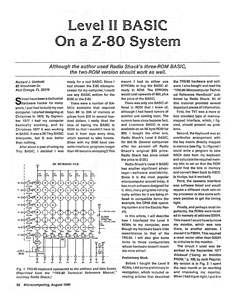 |
"Level II BASIC On A Z-80 System." By Richard J. Uschold. "Kilobaud Microcomputing," (August 1980): 52-66. This article covers the procedure that the author took to get a ROM version of Level III BASIC for the TRS-80 to run on his scratch-built component computer. This scan was made from a low-quality photocopy-- it's readable, but some pages have the tops or part of the sides "cut off." From the article, "I will describe how I interfaced [Radio Shack's Level II BASIC] ROM's to my [scratch-built, component] computer, even though my hardware bears little resemblance to that of the TRS-80. I will give some hints to those computerists whose hardware doesn't resemble mine either!" |
(Electronic News)_tn.jpg) |
Marketing-Sales V-P Named at Nitron. "Electronic News." November 1, 1983. Brief article excerpt: CUPERTINO, Calif. - One-time Intersil vice-president of marketing and sales Edwin Turney has been named vice-president of marketing and sales of Nitron, Inc., which has been pulled from the brink of bankruptcy by a fresh infusion of venture capital. [...] The company's financial woes began a year ago when its principal customer, videogames maker Astrocade, began experiencing cashflow problems. When Astrocade filed for Chapter 11 in December, 1982, Nitron ceased operations and reorganized under a bailout plan that converted $12.5 million in debt to equity and raised an additional $7.5 million from private backers. Mr. Forte said Nitron has "totally written off "Astrocade inventory of $12 million," although the company will sell off that inventory to anyone who wants to buy it." I don't want Nitron to ever be touched again by the video game industry," Mr. Forte said. |
(1984)_tn.jpg) |
Mass Impact of Videogame Technology, The By Tom Defanti Advances in Computers, Vol. 23, 1984 This is a fifty-page "book" from 1984 about how videogames have affected technology. It's written by Thomas A. Defanti, the man behind the ZGrass language and the UV-R computer. Abbreviated "Table of Contents:" 1. Introduction 2. History of Videogames and Related Developments 3. Coin-Op Game Manufacturers 4. Types of Games 5. Market Considerations 6. Videogame Hardware 7. Videogame Hardware 8. Legal Issues 9. Future Developments 10. Conclusions 11. ReferencesAn alternate version is available here. This alternate version has two pages scanned per page. If you plan to print the "book" out, then this is probably the best version to download. |
_tn.jpg) |
"Michigan Bally Users' Group Report" By George Moses. ARCADIAN 3, no. 1 (Nov. 6, 1980): 2-3. Two Astrovision representatives (Ken Charles and Rick Claghorn) attend the meeting of the Michigan Bally Users' Group where they answer user's questions. Four pictures of the meeting are included. |
_tn.jpg) |
"Michigan Bally Users' Group Report: BUG gets a look at Zgrass-32 "add-under" for the Arcade!" by George Moses and Brett Bilbrey. ARCADIAN 3, no. 6 (Apr. 15, 1981): 64-65. Scot Norris from Dave Nutting Associates brings along a Z-Grass-32 prototype unit to the BUG user group meeting and he shows-off the prototype's capabilities. Four pictures of the meeting are included. |
(Ed Horger)_tn.jpg) |
Music-Cade. by Ed Horger. Unpublished Arcadian Submission (submitted April 18, 1983). Suggestions, ideas and methods on how to hook up a music keyboard to a Bally Arcade/Astrocade. Includes a machine language routine that is a "3-voice scan program that provides polyphonic music or, with some modification and additions, a burglar alarm system for every window and door in your home." |
(Paul_Thacker)_tn.jpg) |
"Nitron Company Research." November 2022. by Paul Thacker. According to Bob Fabris in "An Introduction to the BPA," "In 1982, Nitron [was] the principal supplier of hardware to Astrocade." This compilation of information about Nitron first appeared in a thread on the Astrocade discussion group called "Five New Bally (Nitron) Documents Uploaded." |
/Peanut Butter and Jelly Guide to Computers (Excerpt)_tn.jpg) |
Peanut Butter and Jelly Guide to Computers By Jerry Willis with Deborrah Smithy and Brian Hyndman Copyright 1978 ISBN: 0-918398-13-4 This Beginners-type book covers several early videogame and computer systems. The Bally/Astrocade gets a short mention here as the Home Library Computer. The Bally/Astrocade related text excerpt can be read here. |
(1979)_tn.jpg)
|
"Personal Computers: Will Product Come on Fast?" / "Video games: Big Business in 79?" "Sight & Sound Marketing," 1979, Pages 56, 58. This magazine had two consecutive articles that briefly mention the Bally Arcade system. Excerpted from "Personal Computers: Will Product Come on Fast?" Personal computers, which were unheard of but for a small band of hobbyists and businessmen as recently as two years ago, could reach a total sales level of 300,000 units in 1979. [...] "A computer is an interactive piece of consumer electronics. The video games are not; they are restricted in their applications. We are not competing with Atari, Bally or Mattel. If anything, we'll move up, not down, to suit the market," he said. Excerpted from "Video games: Big Business in 79?" "People want to be able to expand use of their programmable video games into a 'home computer,'" asserts Bally's Bob Wiles. "They want software that presents a challenge in terms of complexity and strategy." This said, Wiles expects that 1979 will witness sales of up to a million video games with pricing remaining stable. "The high-end programmable games will shift more into the arena of low-end computers," he said, adding that "software will be stressed heavily in 1979." Bally will be showing at least a half dozen new game programs at the CES (including football), and notes that consumers have been purchasing more than the four to five cassettes per console that they had originally anticipated. The complete articles can be read here:
|
/Personal Computing (1978)(David Bunnel)(Excerpt)_tn.jpg) |
Personal Computing: A Beginner's Guide By David Bunnel Copyright 1978 ISBN: 0801558433 Talks briefly about how "Some video games are beginning to look more like computers as the technology advances, while some personal computers are also beginning to look more like video games. The most glaring example of the merger of these two products is the Bally Professional Arcade." The Bally/Astrocade related text excerpt can be read here. |
/Personal Electronics Buyers Guide (1979)(Excerpt)_tn.jpg) |
Personal Electronics Buyers Guide, The By Charles J. Sippl and Roger J. Sippl Copyright 1979 This book clearly views the Bally Arcade as a computer system rather than a game console. This is an EXTREMELY tightly bound book. For this reason scanning the inside margins was very difficult (some of the text and part of the pictures are missing). For an easier read (but no pictures), read the text version. A text version of all the Bally/Astrocade related material is available here. |
(May 1979)_tn.jpg)
|
"Programmables: Show Business Is In Cartridges" "Consumer Electronics," May 1979: 23. "In a year when the industry is expecting limited growth in programmable video games, major firms in the field will strive to maintain momentum by focusing on new cartridges at Summer CES." "Bally will also be at CES with new cartridges for its programmable, recently upgraded to perform computer functions. The company will introduce two or three new cartridges, including a pinball program, says Jack Nieman, national sales manager."
|
 |
Professional Arcade Gives You More!, The [Advertisment] Electronic Games, August 1982 Full page color advertisement for the BPA. |
 |
Professional Arcade Upgrades To A Computer (No Author Mentioned) Electronic Games, Winter 1981 Astrovision plans revival. Includes the front cover (in color) of this magazine. (1 page, plus cover) |
 |
Programmable Calculators: How To Use Them By Charles J. Sippl and Roger J. Sippl Copyright 1978 A book on how to use programmable calculators seems like an odd place to find references to the Bally Professional Arcade, but it doesn't seem too strange when you remember that the BPA does include a calculator. This huge 526-page book covers all ranges of calculators and explains that eventually the home computer, such as the Bally, among many others, will be taking the calculators place. (3 page, plus cover) Complete text excerpts of the Bally-related material from this book can be downloaded here. |
(Radio Electronics)(Danny Goodman)_tn.jpg)
|
"Video Games - Rolling Your Own" By Danny Goodman "Radio Electronics," September 1983 Details how "the open access to the Astrocade has caused a closely knit and loyal following of Astrocade enthusiasts to band together in users groups and in open exchange of information." (2 pages) This article has been transcribed and it is available here in text format:
|
(Phil D-Angelo)_tn.jpg) |
"Shangri-Logic" By Phil D'Angelo (Shangri-La Video Productions). BASIC Express, The, 3, no. 3 (July/August 1981): 33. This article explains how to use your Bally Arcade system to create titles for your home movies on your VCR. |
(Mike Maslowski)_tn.jpg) |
"SIG Bally" By Mike Maslowski. "Chicago Area Computer Hobbyist," September 1980. A Special Interest Group article published in the "Chicago Area Computer Hobbyist" newsletter. The article is available in text format.
|
(Steve Ditlea)[Excerpt]_tn.jpg) |
"A Simple Guide to Home Computers" (Excerpt) By Steve Ditlea. 1979. The book excerpt includes the table of contents, a complete scan of chapter 7 called "Programmable Video Games," and the index. Chapter 7 covers the Bally Arcade/Astrocade, Cybervision 2001, Odyssey 2, and the VideoBrain.
|
|
|
Space Fortress Review (No Author Mentioned) Video Games, October 1982 Includes the back and front covers (in color) of this magazine. Notice that the back cover lists the arcade versions of Gorf and The Adventures of Robbie Roto! |
_tn.jpg) |
Story of Mike Peace, The (One Peace Band) (No Author Mentioned) Circa 1982. Background about Mike Peace's "one peace band." Mike is the programmer of all of the WaveMakers' games. The article is available in pdf format. |
(june 1982).jpg) |
Test Lab: Astro Professional Arcade By Henry B. Cohen Electronic Games, June 1982 An Astrocade console review that contains a screenshot of an unreleased game (Coloring Book). This is a color article (3.2MB). A smaller (244K) B&W version (without the magazine cover) is also available for faster download here. (2 pages, plus cover) |
(May 1979)_tn.jpg)
|
"Texas Instruments Move Stirs FCC Debate" Consumer Electronics. May 1979. Don't look to Summer CES for a break in the cloud of confusion surrounding the personal computer market. It promises to be even more confused in the wake of the Texas Instrument petition filed with the Federal Communications Commission requesting a change in the rules by which computers are approved and sold. A snarling band of personal computer manufacturers-- stirred by the TI petition-- is forecasting possible product delays or design changes due to the TI action. Doubt about future standards for personal computers will delay product introductions as well as halt production of units introduced, but not yet in production. Bally, for one, will hold off manufacturing its upgraded game/computer introduced at Winter CES until a decision is reached. "We have two units to go with," says national sales manager, Jack Nieman, "the one we showed at CES for around $650 and a lower-priced unit for around $350. But it could cost us millions of dollars if we make a decision on which unit to go with before the FCC makes a decision."
|
(Bob%20Gritzinger)(The%20Brighton%20Argus).jpg) |
"This Moses Wants to Lead You to the Video Land" By Bob Gritzinger. Wednesday, March 10,1982 - THE BRIGHTON ARGUS. This article gives background about how George Moses got started with the Bally Arcade and how he now makes music for the system. This article probably is one of the only places that you'll see a picture of the Blue Ram expansion unit attached a Bally Arcade in the mainstream press. This article has been OCR'ed. A plain text version of it is available for those that prefer it. "This Moses Wants to Lead You to the Video Land" - Bob Gritzinger |
/The Video Encyclopedia (Astrocade Definition)_tn.jpg) |
Video Encyclopedia, The By Larry Langman Copyright 1983 This is the definition of "Astrocade" as defined in the glossary of terms. The full excerpt, in RTF form, is here. The Bally/Astrocade related excerpt, in text form, is here. |
![Video Games [System Comparison]](Video_Games_(Consumer_Reports)/Video_Games_(Nov_1982)(Consumer_Reports)_tn.jpg) |
Video Games [System Comparison]. "Consumer Report" Panelists (No Author Mentioned). "Consumer Report," November 1982. Pages 542-548. "After testing four video-game machines and 76 cartridges, we have our favorites. The list may surprise you." This article chooses the Astrocade as the best game console choice of 1982 (versus the Atari 2600, Intellivision and Odyssey 2). The article's summary concludes: "Overall, our panelists liked the Astrocade best of the four machines we tested. They preferred its hand controls over the others, and they liked the idea of the built-in games. They also thought the graphics and sounds were exciting. Incredible Wizard was the panelists' favorite of the eight cartridges tested for Astrocade, but Bally Pin, Football, Galactic Invasion, and Space Fortress were also popular."
|
|
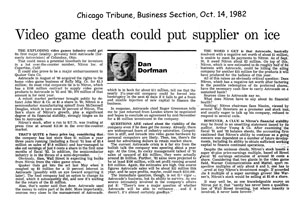
"Video Game Death Could Put Supplier on Ice." By Dan Dorfman. "Chicago Tribune," October 14, 1982. The exploding video games industry could get its first major fatality: privately held Astrocade [formerly Astrovision] of Columbus, Ohio. That could mean a potential bloodbath for investors in a hot over-the-counter number, Nitron Inc. of Cupertino, Calif. [...] Astrocade in August of '80 acquired the rights to the home video game business of Bally Mfg. Co. for $2.3 million; its most vital corporate tie is to Nitron, which has a $108 million contract to supply video game products to Astrocade in '82 and '83; $76 million of that amount is for next year. [...] The immediate question, though, is not the vigor of Astrocade's business, but its ability to survive. As one source intimately involved in the company's affairs put it: "There's now a major question of whether Astrocade will be able to refinance... and if it doesn't, it's almost certainly goodbye."
|
(John Kao)(1989)_tn.jpg) |
The Videogame Design Process By John Kao Entrepreneurship Creativity & Organization: Text, Cases & Readings 1989 This seven-page case study was found via a search of Google Books because there is a brief mention of John Perkins, the programmer of Artillery Duel for the Bally/Astrocade. The case study was written in 1985 and covers the entire videogame industry. If you're a fan of the history of videogames, then you will find some great gems here. This document has given very minimal proofreading, but it is also available in a fully searchable RTF file here. |
|
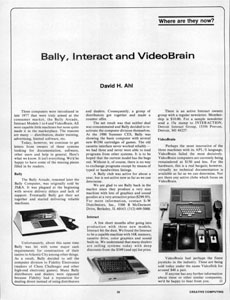
Bally, Interact and VideoBrain By David H. Ahl "Where are they now? Bally, Interact and VideoBrain," CREATIVE COMPUTING, 6, no. 9 (Sept. 1980): 38. "Follow up: Bally, Interact and VideoBrain," CREATIVE COMPUTING, 7, no. 3 (Mar 1981): 48,50. One of the first "articles" that was placed on BallyAlley.com in about 2001 was a collection of two columns, both by David H. Ahl, asking (and answering) whatever happened to the Bally Arcade, Interact and VideoBrain computer systems. The exact source of the columns wasn't known at the time. Now that many complete "Creative Computing" magazines are online it wasn't too difficult to discover when they were published: Sept 1980 and March 1981 . I had supposed that the follow-up column had appeared in the very next issue of the magazine. It actually took nearly six months for people to get more information. What a wait that must have been! The first column poses the question to readers asking what happened to the three computer systems. The follow-up column has the answers along with places to get information about two of the systems. Even in 1981, one of the systems, the VideoBrain from 1977, was long dead. Readers' response to Ahl's request for Videobrain information was underwhelming. Here is what Mr. Ahl heard back about the VideoBrain: "Nothing, zip, zero. People wrote to us wondering where to get cartridges, repairs, et al. But that was it. No one gave us any leads to current dealers or sources. It's almost as though the company, their dealers and most of their customers vanished to another planet." Bally Arcade owners were much luckier! There were plenty of resources for that soon-to-be-christened system called the Bally Astrocade (the hardware was about to get a re-released in 1981 courtesy of Astrovision, Inc.). This historical information makes it plain just how difficult it was for people to get information about their orphaned computer systems. Owners today have a much easier time getting information about long-gone computer systems then owners did even when their systems were near-new. The original pdf of these columns was created from poor photocopies, and the exact date of the columns was unknown. This has been rectified. I've ripped the two color magazine covers and three grayscale pages from the two complete magazines. I've made an entirely new document out of them, which is much clearer. I've always considered these two, short columns must-reads. They allow us to glimpse what many 70s-era computer systems were already facing: computer obsolesce. If you've missed reading these two columns these up to now, then this is a perfect opportunity to try to wrap your head around those long-ago, bygone, some may say, golden years of the early computer era. The original pdf of this article was created from poor photocopies, and the exact date of the columns was unknown. It is available here for archiving purposes.
|
(Fred Rodney)_tn.jpg) |
"Simple Color TV Adjustments - Part II." By Fred Rodney. 1984. Unpublished article submission to the Arcadian. This article explains the potentially dangerous task of adjusting a TV for color purity. Proceed with caution. Archiving Note: Part one of this article was not found in the Robert Fabris Collection.
|
(1980-1981)_tn.jpg)
|
Weekly Television Digest. Bally Arcade/Astrocade Material: 1980-1981. Collected by Kevin Bunch/OCRed by Adam Trionfo. October 2022. This material was posted to the Bally Alley Astrocade Discussion Group on October 8, 2022 by Kevin Bunch. He wrote: "Since I've got some time off, I took Friday to go up to the University of Maryland's library and sift through some years of Weekly Television Digest With Consumer Electronics for video game-related coverage from 1980, 1981 and 1985. For the unfamiliar, WTD was a trade publication that covered the television and consumer electronics industries, and as such covered video games from pretty much the get-go. Anyway, I came across a few Bally Arcade related items that I figured I'd share, including Bally's search for a new owner of their consumer products line, Astrovision's pick-up, and a comment on estimated sales for 1981. Enjoy! [...] Oh I missed one, from October 12, 1981."
|
| Z-Grass 32 Keyboard | Z-Grass 32 Keyboard (No Author Mentioned) Interface Age, April 1981 Short news item that has information on the Z-Grass 32 keyboard expansion unit. (1 page) |
![Video Games [System Comparison] (Cover Scan)](Video_Games_(Consumer_Reports)/Video_Games_(Nov_1982)(Consumer_Reports)_01_(Cover).jpg)