





Download digitally archived Bally Arcade tape programs that will load with Bally BASIC (the BASIC without the built-in tape-interface).
Paul says, "I found the handwritten source code to be easy to read, and only found one error in the two I checked through--Super Wumpus and Down The Trench. I haven't done anything with Hit The Pedestrian, Munch, Submarine Minefield, and UFO Battle, but I'd say these are certainly candidates for typing in."
| Program Name | Source | Comments |
|---|---|---|
| Biorhythms & Moon Landing | Tape | 1980 Biorhythms & Moon Landing was a joint release by Cursor and Sebree's Computing. Along with the two programs, it includes a title screen for the tape. Moon Landing is probably the most sophisticated version of a Lunar Lander-style game I've seen for the system. After landing, you have to take off and dock with another ship, which is pretty tricky. |
| Down The Trench | 1979 Down The Trench portrays an attack on the Death Star. If there's any strategy to avoiding the enemy lasers, the archiver didn't figure it out. But he did finally beat it on an easy difficulty. It's fairly intricate in that it has two stages to the game, plus an ending animation. Instructions and the source listing are available, here. |
|
|
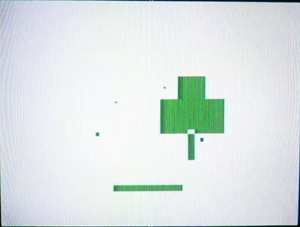
Hit the Pedestrian! Sebree's Computing (Tim Hays). Bally BASIC, 300-Baud. 1979. This game was digitally archived by typing it into BASIC by Paul Thacker in January 2023. In that same month, Adam Trionfo played the game and wrote, "I figured it was going to be a bird's-eye view of the road. Instead, the game is pseudo-3D. The perspective is similar to '280 Zzzap' or 'Night Driver.' The pedestrians move toward the car and they each grow larger as they get closer. Tim had plenty of ambition when he wrote this game, there's no doubt about that fact. I did have a terrible time trying to hit the peds, but hitting the trees came much more naturally to me." This archive includes additional archival material. Instructions and the source listing are available.
|
|
| Joystick Checkout | 1980 A simple program to test your joysticks. |
|
(BB)_tn.jpg)
|
Munch. Sebree's Computing (Tim Hays). Bally BASIC, 300-Baud. 1979. An ex-friend gave you a cookie with a poison raisin in it. You decide to eat this harmless looking cookie. (Until you croak after it’s too late.) Use the joystick to move your mouth around, press the trigger to munch away!! If you get more than 2,000 points, you win the game, if you’re not poisoned by then!! This game was digitally archived by typing it into BASIC by Matt Pilz in January 2023. Matt wrote, "Similar in spirit to minesweeper, except without any clues about where that poison raisin might reside! I enjoyed seeing the use of subtract mode drawing to emulate eating the cookie, with every press of the trigger the area over your square will vanish. It has a mildly creative title screen and if you eat the poison it plays a classic ominous tune." Full archiving notes are included in the game's archive. Instructions and the source listing are available.
|
|
| Star Fire | 1980 "Star Fire is a cockpit-perspective space shooting game. I found it difficult to locate the enemy ships, however. I found this in both Bob Fabris' and Brett Bilbrey's tapes, but in slightly different versions. The one from Brett Bilbrey matches the code on-line, which is labeled as the "H.C. Version." I'm not sure what H.C. means. The one from Bob Fabris has a few lines different, and a comment in the code calls it the "JY VERSION." This version kept crashing on me. It seemed to archive OK, so since the tape doesn't look like a release version, maybe it's just an early prototype. The code on-line also has the Star Fire Assembler. This wasn't on the tapes, and I haven't typed it in." Instructions and the source listing are available, here. |
|
| Star Fire Assembler |
Star Fire Assembler. 1980. The STAR FIRE program uses a user-defined subroutine located in the BALLY's [8k] ROM, this assembler is a program which assembles (writes) a machine language program to store on tape for use in a BASIC program, which CALLs the machine language program from it's location in the Input Buffer. The user can define his own character, and use it any way he wants in the area of graphics. Because the program is in machine language, it runs many times faster and is MUCH easier to use then putting BOXes on the screen with BASIC. Example shows bowling ball character table 9x9 size. [Graphic of bowling ball in binary table not shown] Size of character is specified in lines 150 (Horiz) & 160 (Vert). Character table (at left) [not shown] is stored in lines 210 to 250. GOSUB C increments by 2, GOSUB D increments by 1. You can use table at left by using GOSUB D and input (X=Number), starting with (shown at left) X=28;GOSUBD;X=0;GOSUB D; X=127;GOSUB D;X=0;GOSUB D;X=127...etc. Remember to change the size parameters at 150, 160. If you like what you see that you can do [in machine language, you can order my TUTORIAL on the use of the Internal Subroutines Character Generator. This will cover the complete use of this software, and show the user through examples, how he can CALL his own characters onto the screen and make them move around in REAL TIME, total Machine Language control. TUT.CHAR.GEN.$7.95 Instructions and the source listing are available, here. |
|
|
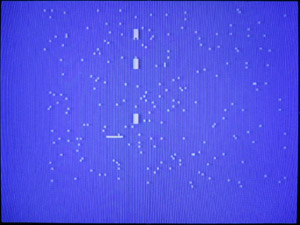
Submarine Minefield. By Sebree's Computing (Tim Hays). Bally BASIC, 300-Baud. 1979. This game was digitally archived by typing it into BASIC by Paul Thacker in January 2023. The dots that appear on the screen are the mines. The object of the game is to get to the right side of the screen without touching any mines (small dots) or depth charges (three moving objects). In the single player mode, your enemy is the three depth charges, they stay very close to you. In the 2 player mode, it is a race to the finish, the depth charges will move back and forth, scanning across the screen. Instructions and the handwritten BASIC source listing are available.
| |
(Sebree's_Computing)(300_baud)_tn.jpg) |
Tape | Super Wumpus. By Sebree's Computing. Bally BASIC, 300-Baud. 1979. Archived from Tape in Paul Zibits Collection. The object of this game is to hunt the Wumpus by moving into a new room each turn and avoiding the hazards. When you think you know where he is, you shoot into that room with one of your three arrows. Each turn, you either move or shoot in one of the three rooms. The Wumpus lives in a cave of 20 rooms. Each room has three tunnels leading to other rooms. Paul Thacker mentions: "I managed to nab the wumpus without falling into a bottomless pit." Instructions and the source listing are available, here. |
(Sebree's_Computing)(300-BAUD)_tn.jpg) |
Tape |
UFO Battle. By Sebree's Computing. Bally BASIC, 300-Baud. 1979. Archived from Tape in Paul Zibits Collection. This game description is from an advertisement in CURSOR 1, no. 3S (March 1980): 3. "UFO BATTLE - 1 or 2 player. On-screen instructions. This game has very dramatic explosions, utilizing color, graphics and sound. The UFO is a different shape every time you destroy one, but it isn't that easy, because at the same time he is trying to shoot you down. A good game for competing against points. Fast running. Memory left - SZ=3 Bytes." Archiving Note: When Adam Trionfo played UFO Battle #2 (filename: "UFO Battle (Version #2) (1979)(Sebree's Computing)(300 baud).wav"), the program appeared to load fine and it played okay on the first play of the game. The program crashed on the second play-through of the game on line 200. Details are contained in the information file in this game's archive. Instructions and the source listing are available: here. |
(Sebree's Computing)(300 baud)_tn.jpg) |
Tape |
XY Tutorial. By Sebree's Computing. Bally BASIC, 300-Baud. 1979. This archive includes the six programs included with the "XY Tutorial." This tutorial demonstrates how to use the BASIC XY command, including achieving some rudimentary perspective. Demonstration Program #2 on page 5 of the tutorial has a program, and then some additions to the program. The tape just had the program followed by the additions, but the program has been archived in two versions: both with and without the extra lines. The tape didn't include the short program on page 7, but it was typed-in and called Demonstration Program #4. Finally, there's a cool flight-simulation type program." 1) 3-D Forward Simulation Above A Flat Plane 2) Cartesian Coordinates To XY Values Routine 3) Demonstration Program #2 4) Demonstration Program #2 (with Additions) 5) Demonstration Program #4 6) RND XY Value To Perspective Point Read the 12-page "XY Tutorial" for BASIC, here. |