





Download digitally archived Bally Arcade tape programs that will load with AstroBASIC (the BASIC with the built-in tape-interface).
 |
Programmed several programs for the Bally Astrocade. |
 |
Programmed several programs for the Bally Astrocade. |
 |
Programmed several programs for the Bally Astrocade. |
 |
Programmed several programs for the Bally Astrocade. |
 |
Programmed several programs for the Bally Astrocade. He was also part of General Video (along with Dave Ibach). |
/1024_(2023)(Tony_Mokonen)(AstroBASIC)(2000-Baud)(Screenshot)_11.png) |
"2024." By Tony Mokonen. 2023. AstroBASIC. Tony says, "I do have a second game completed. It's a version of 2048 (https://play2048.co/). I divided all the numbers by 2, because I didn't want to overflow the 16 bit variable I was using to keep score. It's written very generically, using no graphics and the & array to generate sound, so that it will run in different versions of BASIC. I did that because I wanted to use it as benchmark to test the speed of the various versions of BASIC on the Astrocade. It's actually quite a noticeable speed difference between the original Bally BASIC and the versions that came later. Blue Ram Basic is the winner as far as speed." Commented BASIC source code is included. |
| 3 Songs, 3 Voices | "3 Songs, 3 Voices" By Dick Harris 198x Bob Fabris Collection. Unpublished "Arcadian" submission. |
| 64K Data & Op Code Converter |
64K Data & Op Code Converter By Jim Dunson 198x Source: Tape from Bob Fabris Collection. This unpublished Arcadian submission converts numbers between binary, decimal, and hexadecimal; two versions are have been archived. Experimentation with converting decimal to hex led Jim to discover that there were no published programs that dealt with the negative decimal. The only one that he could find went from 0 to 32767 or 7FFF. He then developed a very fast entry and easy to use program that converts all 64K. |
| ABC Hobbycraft Christmas Card |
ABC Hobbycraft Christmas Card By Guy McLimore December 1983 Source: Tape |
(Adam_Trionfo)(AstroBASIC)(Screenshot)_02_Color_255.png) |
"All 256 Colors." By Adam Trionfo. 2020. AstroBASIC. This utility was written as a test program to help identify the color issues with the Astrocade emulator that is part of MAME. It was inspired by "Color Wheel" from the "AstroBASIC" manual. The program displays the background color in all 32 colors and 8 intensities (for a total of 256 colors). Each screen displays the BASIC color (0-255), the Background Color 0-31 and the Background Intensity (0-7). After each screen is displayed, there is a short pause before the program proceeds to show the next color in the sequence. This program should still be considered in beta testing. See the included documentation for how you can help test this program. |
| Alpha |
"Alpha" By Fred Olivas. 198x. Source: Bob Fabris Collection. This is an unpublished Arcadian submission. It includes a text title screen. No additional information about this program is available. |
(John W Rhodes)(Screenshot)_tn.jpg) |
Bally Artillery. By John W. Rhodes. Creative Computing, August 1982, Pages 191-192. John Rhodes writes: "I particularly liked the artillery game that Compucolor called 'Shoot.' This game generates a random terrain display and wind factor and positions two artillery emplacements on the screen so that two opponents can take turns trying to obliterate each other. Eventually I resolved that I either had to buy a Compucolor or program this game on my Bally. I chose the latter. Lance Squire typed in Bally Artillery in June of 2018. It runs, but doesn't work exactly as it should. It probably has a couple of typos in it, but it's still worth looking at and playing. The original article and type in "AstroBASIC" listing is available here: A video of the work-in-progress Bally Artillery is available here: |
(Bally)(2000 Baud)_tn.jpg) |
"Bally BASIC Sampler." Written by Dick Ainsworth. Released by Bally in 1978. This tape was included with the 300-BAUD Tape Interface for the Bally Arcade/Astrocade. It contains two BASIC programs on each side. Each program contains at least three BASIC examples. The following programs are on the two-sided tape. Side 1:
|
(Matt_Pilz)(2000_Baud)_tn.jpg)
|
Bally Snowflake: Vintage Computing Christmas Challenge 2022. By Matt Pilz. December 2022. This AstroBASIC program produces an endlessly altering snowflake drawing. The variations it generates can create a real glistening look to them, even with speckled snow frosted across it at times! This video art was first posted by Matt Pilz to a thread on the Bally Alley discussion group on Groups.io called Christmas Snowflake Challenge 2022: Bally Edition on December 28, 2022. This program archive contains a wealth of additional material, such as pictures and additional information about the program. Matt wrote, "For fun I took a stab at the popular 2022 VCCC Christmas Challenge of generating an eight-point star (snowflake) in any BASIC language. I went with the one nobody else had bothered with... Bally! But to make it more interesting I used the 'Wild' category and line art that varies endlessly as the program runs. I plan to make a second video showing the coding process and actual code involved, which is around 270 bytes worth without optimization. Bally only has 1800 bytes available for programming and all code has to be typed using a 24-key calculator." Matt created a couple of videos for this program:
|
| Bowl |
"Bowl" By Edge Software. 1982. Archived from commercial tape "Tape #1" in Richard Houser's collection. ARCADIAN 4, no. 3 (Dec. 24, 1981): 31. (Ad) ARCADIAN 4, no. 7 (May 07, 1982): 71. (Ad) ARCADIAN 5, no. 2 (Dec. 3, 1982): 29. (Ad) This is a 2000-Baud game for use with AstroBASIC. Use the joystick to move the ball up and down, the knob to control spin, and the trigger to throw. Instructions from Edge Software advertisement, dated June 14, 1982, sent mailed as requested: This bowling game, for one or two players, has complete scoring and ball action controlled by the joysticks. A number is shown next to the scoreboard - first which bowler is up, and then how many pins were knocked down. The ball's position behind the foul line is changed by the bowler's joystick. The further back from the foul line, the faster the ball will travel. Turning the knob will put spin on the ball so that it hooks in either direction. A center position of the knob will result in a straight ball. The impact of the ball is wider and deeper as the speed increases. The ball is released by pulling the trigger. If it is released over the foul line, the ball is removed and no score results. If it hooks too much, it will roll down the gutter. When there is only one player, or if you want to skip a player's turn for some reason, press "1" before the first ball of the frame is rolled. Scoring of all frames is complete with strike, spare and open frame indicators. When the game is over the alley is removed from the screen. To play another game simply press "0". |
| Budget Program |
Budget Program By Jim Dunson (possibly) 198x Source: Tape from Bob Fabris Collection This is an unnamed budget program. It may be by Jim Dunson, as it was found on the same tape as "64K Data & Op Code Converter," which is a program by him. |
| Capture the Dogs |
Capture the Dogs By James Wilcher Source: An unpublished Arcadian submission from the "Bob Fabris Collection" From the submission letter to the "Arcadian:" "To play the game you're moving up the screen under the Computer's control and you use your joystick to move in right or left [directions] and try to Eat the Dogs without running into the walls."
|
| Carnival Rapture |
Carnival Rapture By Tim White Source: Niagara Bugs Club Tape 1 Original music by Tim White (Mike White's brother). |
| Castle Bally |
Castle Bally By Paul Pank Release: August 2005 Source: Bally Alley Discussion Group Includes review. |
.jpg) |
"Cavern Quest." By Bruce Jaeger. Creative Computing 9, NO. 7 (July 1983): 222, 224-225. This is a text adventure game that uses the joystick for input from the player. The game is large, random and pretty fun (if you map it!). "The scenario of the game is straight-forward. Jesse James, the Robin Hood or Attila the Hun of Missouri (depending on your point of view), has hidden a treasure deep in a cave, and you want to go in, find it, and bring it out. That's it. No magic birds, sword-wielding ogres or dissembling oracles. Not only would that have been quite a task in 1800 bytes, but it turns out that a simple, realistic exploration of a three-dimensional cave is difficult enough, thank you. The cavern passages do not form a traditional maze, as there is often more than one path to the treasure, and any path is liable to loop back on itself-sometimes in an inexplicable way. Make a map."
|
| Checker II |
Checker II By Collins Computer Company Source: Tape This is the Astro BASIC version. The Bally BASIC listing is in the Arcadian, Vol. 2, Page 10 and 12. |
| Chicken! |
"Chicken!" By The Bit Fiddlers (Andy Guevara) Release: August 1982 Source: Tape It's late... you've got to get your brood home in time to watch "Fowl Play." The only problem... there's six lanes of freeway between you and home. And every day it seems to get worse... CHICKEN! is a one or two player game of skill. It pits each player against six lanes of highway of ever increasing traffic density. The object, of course, is to get your chickens across the road. This version of the game loads via AstroBASIC. The original instructions for the game can be downloaded here: "Chicken!" Instructions - PDF A disassembly of a cartridge conversion of the game can be downloaded here: "Chicken!" Disassembly - Zipped Disassembly and Binary ROM |
| Circle Plotter |
Circle Plotter By Barry Ellerson Source: Arcadian, Vol. 3, No. 3, Pg. 33 (January 1981) and Arcadian, Vol. 6, No. 7, Pg. 65 (May 1984) This was a 300-Baud program on tape that was converted to 2000-Baud using Jay Fenton's AstroBASIC utility "300 Baud to 2000 Baud Tape Conversion Program." This program was first printed in the Arcadian for Bally BASIC in 1981, then it was reprinted in 1984. Mike White's software list says this was a modification (presumably for Astro-BASIC), but it looks like the code printed is identical. Apparently it should have been modified, however, because line 5, the first line of code, works fine in Bally BASIC, but gives an error in Astro-BASIC. 5 CLEAR ;:RETURN ;NT=0 It seems like Astro-BASIC doesn't like the :RETURN. It was removed and then the program seemed to run fine. |
| COH (proto) |
"COH" (proto) By (possibly) Ken Lill. 198x. Source: Ken Lill Tape Collection. This archive contains several different versions of an unfinished game. You can move a robot "sprite" around the screen, and it flashes when you run into some background elements, but that's all. Another version adds two robots that were just background elements, that can now be controlled by player 2. Pushing left and right on the joystick moves the left character left and right, while pushing up and down on the joystick moves the right character left and right. |
| Collatz Conjecture, The |
Collatz Conjecture, The By Jim Dunson Release: August 1984 Source: Astro-Bugs Club Tape #5 This program is a mathmatical demonstration. From the game loading screen: "About 30 years ago [1937] a professor named Collatz created this thought provoker. Start with any whole number. If it is odd, triple it +1. If it is even, take half. Repeat. The final result will always be one. Why is that? After all, the odd number is tripled + 1. This more than compensates for the halves???" |
| Color Pick 2 |
Color Pick 2 By Lance Squire Release: 2011 Source: Internet This AstroBASIC program is used to determine the hex value associated with the Bally/Astrocade color ports. The user inputs numbers in HEX using the controller in port 1 and by pressing left/right and up/down. The screen color changes immediately with each change of input. It is very convenient to use "Color Pick 2" as a quick way to determine what the color required in a machine language program. Additional information about "Color Pick 2" can be read here. |
(AB)_tn.jpg) | "Bally-AHL Benchmark." (AKA: "Creative Computing Benchmark from 1984"). By Matt Pilz (original version by David H. Ahl). July 2, 2023. On July 2, 2023, Bill Loguidice wrote, "[This is] a 1984 analysis of the performance of various computers and similar devices with BASIC. There are some odd inclusions and some notable omissions, including the Bally Astrocade. Has anyone ever tried to run a version of that BASIC program on the Astrocade to try and see what the performance might be in comparison?" On the same day, Matt Pilz wrote, "I just did! The problem with that particular benchmark and Bally is that out-of-the-box AstroBASIC does not support floating numbers, built-in square root or exponents. I made revisions to the script to conform to Bally’s capabilities, including use of a basic square root function from the Sebree’s Math Functions. [...] To my surprise this puts it speed-wise ahead of the bottom 25 on the list, including the TI-99/4A, Atari 400/800, ZX Spectrum and Sinclair 2068."
|
| Critter |
Critter By Brett Bilbrey Release: December 1980 Source: Arcadian, Vol. 3, Page 13 (No explanation), Cursor, Vol. 2, Page 65 (with Explanation) This program will place a Space Invader-type "critter" on the screen that will bounce around from top to bottom and side to side without disturbing anything on the screen. His speed is controlled by hand control #1. This is a machine language program that uses the Bally/Astrocade's Vector motion routines that contained on the on-board ROM. An article by Adam Trionfo on how this machine language program was converted from Bally BASIC to AstroBASIC is here. |
(Adam Trionfo)_tn.jpg) |
Crosshatch. By Adam Trionfo. June 5, 2017. First available on BallyAlley.com. This short "AstroBASIC" program draws a crosshatch pattern to the Bally's screen using the '#' marks. The program was written so that a digital camera can be pointed at a TV screen to take pictures (screenshots) and videos. The pattern helps to focus the camera and check for level, as well as to center the TV in the frame. |
/Dungeons_and_Dragons_Character_Maker_and_Dice_Roller_(198x)(David_Sohinki)(Screenshot)_01.png) |
"Dungeons & Dragons Character Maker and Dice Roller." By David Sohinki. 198x. AstroBASIC/Bally BASIC. David writes, "It will help with making a Dungeons & Dragons fantasy adventure game. It rolls a character and the dice." Paul Thacker noted when he archived the program, "Choose between various dice types to roll, or generate random character stats." This is an unpublished program submission to the "Arcadian" newsletter from the early-to-mid 1980s written by a 13-year-old named David Sohinki. Note that option 6, which says on-screen that it will roll a 12-sided die actually rolls a 20-sided die. This is okay, as that is what the option should say on the screen. This is program submission letter to the "Arcadian" newsletter:
|
 |
"Finders-Keepers" By Gambits (Ken Lill) Release: 198x Source: Tape From two to four people compete at the same time: Try to find the Secret Dot that the computer has selected in your area before your opponents find the one in their areas. Finders-Keepers - Instructions |
| Goldfish Demo |
Goldfish Demo By The Bit Fiddlers (Andy Guevara) Release: 1982 Source: Goldfish Demo Tape Seven goldfish swim around a fishtank, a clock runs, and a cat meows every minute. An example of a smooth machine language program. |
| Graphic |
"Graphic" By unknown author. 198x. Source: Bob Fabris Collection. This program was found in the Bob Fabris Collection on a tape that also included "Mazemaker," "Memory Doodle," and "Treasure Hunt." The tape label starts out with "Graphic - " followed by something illegible. It includes a graphic title screen with "Bob" spelled out in blocks on a graph, as can be done in the program. |
| Graphics Quadruplicate |
"Graphics Quadruplicate" By Jim Dunson. 198x. Previously unpublished program submission to Arcadian. AstroBASIC. This is an unpublished submission for the $100 "Arcadian" program cash prize. This program is from the Bob Fabris Collection; it includes a text title screen. This program uses right angle lines and XY operator to create unusual and very fast graphic art. The program was created to run in AB. It will run in BB, however the effect of speed of operation is lost. The redundancy of LINE statements is deliberate in order to increase the speed of operation. 4 colors are shown in parts 1 & 3 and 8 in part 2.
|
| Duck Hunt | "Duck Hunt" By Jim Wilcher 198x Bob Fabris Collection. Unpublished "Arcadian" submission.
|
| Duck Hunter | "Duck Hunter" By Louis Gubernatis 1982 Bob Fabris Collection. Unpublished "Arcadian" submission. |
| Exterminator |
"Exterminator" By Phil Bauer. 1982. Unpublished Arcadian submission from Bob Fabris Collection. AstroBASIC, 2000-Baud. Exterminator is a fast-moving maze-type game for up to four players using joystick controls. In the Bob Fabris collection was a hand-written letter, game instructions, and hand-written BASIC LISTing for "Exterminator." I have also added a BASIC LISTing of the program to the pdf, probably made by Bob Fabris on his printer. I have typed the letter and instructions to give the game some character so that it is not just an anonymous program floating around the Bally Arcade program area. The letter has had some basic proofreading done, but I tried to leave it as-is. The re-typed letter and instructions are included in the the archive. The original version can be viewed here: |
| Golf | "Golf" By Jim Wilcher 198x Bob Fabris Collection. Unpublished "Arcadian" submission. |
| Guess Number |
Guess Number By: (Unknown) Release: (Unknown) |
| Happy Birthday Song |
Happy Birthday Song By Lance Squire Release: August 2011 Source: Lance Squire This is the song, "Happy Birthday to You." This program was specially written as a birthday gift for Adam Trionfo. You can read more about how to load it and the clever way that Lance sent it to Adam, here. |
| Happy Days |
Happy Days By Peggy Gladden Source: Michigan Astro Bugs Tape 2 This is the theme music for the "Happy Days" television show. |
| Hi-Q-Solitaire |
Hi-Q-Solitaire By: (Unknown) Source: Astro-Bugs Club Tape #1 Jump pegs over pegs until no pegs are left... or as few as possible. |
 |
ICBM Attack (Beta) By Brett Bilbrey Source: Brett Bilbrey Tape Collection Two early versions of I.C.B.M. Attack by Spectre Systems. These should be loaded with :RUN. They're not actually playable games at this stage. |
| Kaleidoscope |
Kaleidoscope By: (Unknown) Source: Astro-Bugs Club Tape #1 A mirrored drawing program. |
| Koncentration | "Koncentration" By Edward Mahoney 1984 Bob Fabris Collection. This is an unpublished Arcadian AstroBASIC program submission sent to Bob Fabris on June 6, 1984. Instructions were included with the cover letter sent to the "Arcadian." This is a two player game using the trigger to start play and the keypad to enter the box numbers for matching. Points are awarded based on the numeric value of the letter matched. Bonus points are awarded if a "$" dollar sign is matched with a letter.
|
| L&M Title Screen Creation Method |
L&M Title Screen Creation Method By: Various Source: Adam Trionfo Date: 2011 This is a limited overview of a method that can be used to create a new title screen for a L&M Software program. This method was used to create a title screen for "Sink the U-Boat." Previous experience archiving Bally/Astrocade programs is probably necessary to follow this overview. It would also be helpful to have used "Repacker," but you can probably get by without knowledge of that Astrocade Blue Ram BASIC Utility and learn as you go. Detailed instruction on how to use these programs and method are here |
| Lunar Lander |
"Lunar Lander" (proto) By unknown author. 198x. Source: Ken Lill's Tape Collection AstroBASIC. This start of a game was found on a hand-labeled tape in Ken Lill's tape collection along with a couple of programs printed in the "Arcadian" ("Frogway" and "Flaps Up!"). There appears to be no way to control the ship. If you look up "Lunar Lander" in Mike White's software list, then you'll find four versions, and that doesn't even include Ron Picardi's unpublished program. Paul looked at the code and couldn't identify its origin with any confidence. |
| Mastermind | "Mastermind" By Dick Harris 198x Bob Fabris Collection. Unpublished "Arcadian" submission. |
| Match |
"Match" By Edge Software. 1982. Archived from commercial tape "Tape #1" in Richard Houser's collection. ARCADIAN 3, no. 12 (Oct. 05, 1981): 122-123. (BASIC Listing) ARCADIAN 4, no. 3 (Dec. 24, 1981): 31. (Ad) BASIC Express, The 3, no. 1 (April 1981): 9-10. (BASIC Listing) ARCADIAN 4, no. 7 (May 07, 1982): 71. (Ad) ARCADIAN 5, no. 2 (Dec. 3, 1982): 29. (Ad) This is a 2000-Baud game for use with AstroBASIC. This is very close to the version printed in The Arcadian, but does have some minor formatting differences. Directions from the "Arcadian" newsletter: The object of this board game, for either one or two players, is to select the pairs of cards (A to T) which have matching numbers (0 to 9). As letter guesses are entered on the key-pad the cards are "turned over" to reveal the numbers. If a match is made the two cards are removed from the board and the player tries two more cards. If a match is not made the cards are turned down again. If there are two players, they take turns guessing two cards at a time. At the end of the game the number of pairs matched for each player is shown. If there is just one player the number of tries needed to complete all 10 matches is shown at the end. The challenge is to have as few tries as possible--- 10 would be a perfect score. Both the color and a number of the right of the screen indicate which player should enter a letter (blue is #1, red is #2). A short instruction at the beginning explains what to do. |
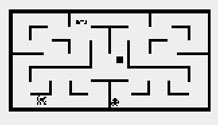 |
Maze Avenger By: Dale Low Source: ARCADIAN, 6, no. 11/12 (October 31, 1984): 100. Date: 1984 Note that the Arcadian newsletter provided no instructions on how to play this game, but plenty is provided here. "Maze Avenger" is a maze game where the player's character creeps ever so slowly around the maze shooting objects that are not at all easily identifiable. When the character shoots all of the objects on the screen then the player advances to the next level. The player can be hit by-- well-- SOMETHING and it causes the player to be unable to shoot and also to be able to pass through walls. The detailed background and instructions for "Maze Avenger" are here "Maze Avenger" unofficial instructions and tips here: here "Maze Avenger" does not save like a BASIC-only program. See how to work around this problem to be able to save both the BASIC and machine language portion of this (or any) program, here An assembly language disassembly and commented BASIC program for "Maze Avenger" is available here. |
| Memlyzer | "Memlyzer" By Dick Harris 198x. Bob Fabris Collection. Unpublished "Arcadian" submission. |
_tn.jpg) |
"Michigan Astro Bugs, Tape #1." Compilation of Programs. By Various Authors. 1983. This is the complete tape working as intended. You choose a game from the menu and it will load automatically. This version preserves the original distribution process of the tape, but it is slow to load a game. You load a menu, pause the tape, choose one of the programs, then start playing the tape again. Small 41 byte sections help identify the programs so the correct one loads when that section of the tape is reached. This menu system does not currently work in MAME (as of August 2023), but all the programs load correctly on real hardware. Side 1: ------- 1) Bots II (Steve Walters) 2) Astro Black Box (Steve Walters) 3) Home Budget Keeper (George Moses) 4) Red Pop Music (George Moses?) 5) Nam Cap Ver. 4 (New Image) 6) Frog Leap (Ben & Dave Ibach) The menu only displays options 1-6, but you can also enter 7 for the final program, "Music Keyboard" by WaveMakers. Side 2 ------ 1) Kaleidoscope (?) 2) Hangman (W&W Software) 3) Super Scribble (Spectre Systems) 4) Slot Machine (W&W Software) 5) Biorhythms (W&W Software) 6) Hi-Q Solitaire (New Image) 7) Music Keyboard (WaveMakers) |
| Michigan Astro-bugs Tape II (Compilation) |
Michigan Astro-bugs Tape II (Compilation) By Various Authors Source: Michigan Astro-bugs Tape II This is the complete tape working as intended; you choose a game from the menu and it will load automatically. This version preserves the original distribution process of the tape, but it is slow to load a game. For convenience it is recommended to load each program separately (the programs can be found elsewhere). The eight programs that are included are: Side 1: ------- Starbase I - By Creg Miejski Wack-A-Mole - Wavemakers Happy Days (Music) - Norman Gimbel & Charles Fox (Peggy Gladden) Rockin' Robin (Music) - Bobby Day (Peggy Gladden) Side 2 ------ Snare A Bear - Stanley Kendall W&W Racetrack - W&W Software Sales Memory Lane - Wavemakers Color Patterns - Stanley Kendall |
(Dan Sandin)(AB)_tn.jpg) |
Mod 2. By Dan Sandin. Computer Graphics and Art, 1980-1981 Yearbook 5. MOD 2, is a Bally BASIC video art program, that appeared in an article called Pix-Art by Frank Dietrich and Zsuzsanna Molnar. This article covers the Bally Arcade as a low-cost solution to create graphics using Bally BASIC and the ZGrass language. It specifically talks about several pieces of art that were written using the two languages. Some of the video art pictures are included in the article, as well as some source code for a few programs. Dan Sandin's program needs about fifteen minutes to finish a single one of these MOD images, consisting of circles which seem to be mapped onto globes. This compact 10-line program uses only two nested loops to create the basic structure which scans the whole screen. |
| Musical Notation Graphic | "Musical Notation Graphic" By Dick Harris 198x Bob Fabris Collection. Unpublished "Arcadian" submission. |
 |
Niagara Bugs Club Tape (1985)(Mike White)(Sides 1 and 2) By Various Authors Source: Niagara Bugs Club Tape This is the Niagara Bugs Club Tape, complete with a functioning menu. Paul Thacker says, "Yes, multi-load menu-based programs are pretty annoying, but I'm glad to have it working as originally intended." Side 1: ------- 1) Menu 2) Crossing Signal - By Mike White 3) An Artistic Display - By Mike White 4) Bowling - By Mike White 5) Fireworks - By Mike White 6) Hangman - By Mike White 7) The Tin Pants Gang - By Mike White 8) Putt-Putt Golf - By Mike White 9) Bingo Caller - By Mike White 10) Space Mission (2 player) Part 1 - By Mike White 11) Space Mission (2 player) Part 2 - By Mike White Side 2 ------ 1) Menu - By Mike White 2) Sound Variable Study - By Mike White 3) Lizzard Lunch - By Tim White 4) Treasure Hunt - By Tim White and Mike Kinkead 5) Carnival Capture - By Tim White 6) Paraschot - By Tim White 7) Simon (mod) - By Brett Bilbrey, Modified by Mike White 8) Treasure Hunt (mod) - Mike White 9) Repack (AB + 8K) - By Mike White 10) Space Mission (4 player) Part 1 - By Mike White 11) Space Mission (4 player) Part 2 - By Mike White |
/Okiedada_(1983)(THADDxPRO)(AB)_tn.png)
|
"Okiedada." By THADD*PRO (Tim Henson and David Dalke). July 15, 1983. Previously Unpublished. In "Okiedada" you try to defend your city from falling meteors. You can also accumulate points by hitting the mini-space ship in the upper-left corner of the screen, but in doing so you may sacrifice a hit on your force-field. There is a bonus point meteor that is signified by a series of tones that also falls. Use your joystick for target-control movement in your trigger for firing. (Hint - At 3,000 points exactly shoot the mini spaceship!) Archive Note: "Okiedada" was never published as a type-in listing or released on tape for the Bally Arcade/Astrocade. It was sent to the "Arcadian" newsletter with another game called "Caterpillar" in 1983. "Okiedada" was archived from the BASIC type-in listing by Adam Trionfo in August of 2023. He typed it in using the Astrocade emulator in MAME. |
| One Arm Bandit | "One Arm Bandit" By Norm Kapera 198x Bob Fabris Collection. Unpublished "Arcadian" submission. This program simulates a Slot Machine.
|
| Pac*Man |
Pac*Man By Dale Low Source: Tape from Bob Fabris Collection "Pac*Man" (as the name appears on the tape) appears to be an unused Arcadian submission. Dale Low was the programmer behind Astrogames, a tape company. Astrogames published a game called Super-Pac, but this is probably not the same thing. |
(Ron Picardi)(Screenshot 10)_tn.jpg) |
Pick A Pattern. By Ron Picardi. 1980 or 1981. Unpublished Arcadian Submission. Pick A Pattern allows you to make your own patterns, which works... but I don't really know how to choose options that make good patterns. The random element (option 2 on the menu) makes some of the most random, ultra-cool video art that I've ever seen on the Bally system! I let it run for a while now and I snapped pictures of the coolest-looking output. It's too bad that Ron Picardi didn't simplify this program and eliminate options 1 and 3, which require LOTS of user input. This probably would have made the program publishable (and much shorter in length). As it is, it stands, I believe, as one of the most interesting (probably THE most interesting video art program) on the Bally (in either published or unpublished format). The only issue that I have with it is that some of the art it makes takes a long time to finish. This is because it's totally random for how many iteration each drawing cycle runs. I guess that's also part of the beauty of the program. Ron included rudimentary instructions on how to use PICK A PATTERN with in his program submission letter. Although Ron's documentation may seem long, they are basic on the details: |
| Pin Art I |
Pin Art I By (Unknown) Source: Richard Houser's Tape collection |
| Pinball I |
Pinball I. By Mark Keller. 1980. Archived from unpublished "Arcadian" submission tape in Bob Fabris Collection. "Pinball I" is a simple pinball game (no gravity). It will prompt for parameters, triggers 1 & 2 control the flippers. [Use the player 1 trigger for the left flipper, and the player 2 trigger for the right flipper.] They stay on a set period of time when used and then are disabled for a set period of time. This is a 2000-Bally "AstroBASIC" conversion of an original 300-baud BALLY BASIC program. See archive notes for additional details. |
| Rockin' Robin |
Rockin' Robin By Peggy Gladden Source: Michigan Astro Bugs Tape 2 Bobby Day's 1958 hit, Rockin' Robin. |
| Sound Graph |
Sound Graph By Chuck Thomka Source: ARCADIAN, 1, no. 8 (July 1979): 65. "Sound Graph" is part of the "The Music Synthesizer" tutorial by Chuck Thomka. In order to understand what "Sound Graph" is doing, the user must read the tutorial or at least have previous knowledge of the sound ports. With this knowledge, then you may be able to make some noises, but you won't be able to understand why they work or really what is happening. There is a link to the tutorial below. "Sound Graph" is an eary BASIC program that allows direct access to the sound ports. The user can try making different sounds by changing the ports with an interface that uses hand controller #1. For additional information, there are more documents available: |
| Starship |
"Starship" By Ken Lill Source: Ken Lill Collection. Paul Thacker's archive comments, "Starship seems unfinished to me. You can shoot the enemy ship by pulling the trigger, or bomb it by pushing the joystick left of right. But there's no way to aim, you just always hit, and once you run out of ammo, you can only wait until the enemy ship destroys you." |
| String Array Loader | "String Array Loader" By Allen W. Skaggs 1983 Bob Fabris Collection. Unpublished "Arcadian" submission. |
| Super Scribble |
Super Scribble By Brett Bilbrey Source: Astro-Bugs Club Tape #1 An interesting paint program that can save and load. |
| Super Simon |
Super Simon By Klaus Doerge. 198x. Archived from hand-labeled tape in Ken Lill's collection. This was never published as far as Paul Thacker can tell. |
/Sweet_Dreams_(1983)(Allen_Skaggs)(2000_Baud)_tn.jpg)
|
"Sweet Dreams" By Allen Skaggs. February 14, 1983. AstroBASIC. This video art program was archived on November 12, 2025 by Paul Thacker from the Allen Skaggs Collection that was purchased by Even Twelty in 2025. Paul writes, "Nice find, though that's combined with some sadness as I remember Allen posting to the group. I don't recall knowing that he had any tapes. He had two Blue RAM BASIC programs printed in The Arcadian (Armchair Artist and Calendar Program), then a few unpublished submissions found in the Bob Fabris collection. [...] I took a quick look at the 51 program tape and was able to get Sweet Dreams running easily enough. It's Adam's favorite--a random art program." Here is an additional link:
|
| Telephone Directory | "Telephone Directory" By Allen W. Skaggs 1983. Bob Fabris Collection. Unpublished "Arcadian" submission. See the audio recordings from Allen Skaggs tape for more information on these submissions. Allen says that he renamed this one to Telephone Directory, but the program still says Crypto-Scrambler. |
/Self-Portrait (1979)(Guy McLimore Jr)(Screenshot 01)_tn.jpg) |
Self-Portrait: A Graphics Demo. By Guy McLimore, Jr. April 10, 1979. Hand-written BASIC listing from an unpublished ARCADIAN submission. This program draws a simple Bally Arcade unit. |
(Spectre Systems)_tn.jpg)
|
Spectre Control Handle Demo Programs Spectre Systems. 1983. This archive contains three "AstroBASIC" programs for use with the Spectre Control Handle, often called the ICBM Attack controller. These programs are from the Spectre Handle documentation: The three programs are:
|
(Michael_Prosise)(Screenshot)_01.png) |
"Three Programs." By Michael Prosise. 198x. AstroBASIC. Michael Prosise wrote a Bally Arcade/Astrocade game review column called "The Game Player" that appeared in the "Arcadian" newsletter from October 7, 1982 through October 31, 1984. This archive contains three programs found on tapes from Michael's collection, two of which are programs that were modified by Michael. The programs are:
|
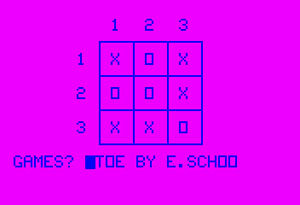 |
Tic Tac Toe. By E. Schoo. 198x. For AstroBASIC. This is a simple, two-player game of Tic-Tac-Toe. The archive has the instructions recorded as an audio file and a transcription is also included. Paul Thacker noted on December 6, 2021: "I've archived Tic Tac Toe by E. Schoo. Thanks to Allen Schweitzer for loaning me this tape. This program seems to be completely unknown, and a quick search didn't reveal anything about the programmer. This is a reminder that for all the programs published or advertised in a newsletter, there were probably many more that people just experimented with on their own. [...] So far as I can tell, this program was never published. The tape was included with an eBay purchase, but no further details of the source are known." |
| Touch Tone Simulate |
Touch Tone Simulate By Chuck Thomka Source: ARCADIAN, 1, no. 8 (July 1979): 65. and modification from ARCADIAN, 2, no. 10 (Sept 1980): 90. "Touch Tone Simulate" allows the user to type in a phone number, and then dial it by placing a phone near the TV speaker and then pressing PRINT. The Bally Arcade will automatically dial the phone number. Make sure that when you use the program that your TV's volume is set to a high enough level so that your telephone can "hear" the TV. For additional information, there are more documents available: |
| Treasure Hunt |
"Treasure Hunt" By Scott Walpole. 1982 (Published/Printed in 1983) By Scott Walpole AstroBASIC and Bally BASIC This is an unpublished "Arcadian" game submission found in the Bob Fabris collection. It was submitted on May 25, 1983 to the newsletter for consideration for the $100 monthly programming contest. "Treasure Hunt" is played on a 9x15 grid. Hidden under the squares in the grid are objects randomly placed by the computer at the beginning of the game. Each player, in turn, selects one square by moving the marker with the joystick and uncovers it by pulling the trigger of his hand control. The object of the game is to first find four hidden "keys" represented by the numbers 1, 2, 3, and 4.
|
(Matt_Pilz)(AB)_tn.jpg)
|
Vintage Computing Christmas Challenge 2023 - Bally Edition. By Matt Pilz. December 2023. AstroBASIC. Matt wrote, "I opted to pursue the 'wild' category to exercise much more creative freedom than the strict depiction expected in the main challenge. I always enjoy adding additional elements of snow/winter to these themes and find Bally’s graphic capabilities, however limited, to be helpful in that regard. The snowflake demonstration last year received a fair deal of praise and more importantly introduced people to the Bally itself, since many including the event organizer had not heard of the system prior to that. "[..] One of the biggest limitations with Bally to complete these challenges more strictly is that the viewport can only squeeze in approximately 15x11 characters, making it too narrow to fit in the full pattern. The alternative as used here is to visually draw the necessary objects using the box and/or line commands. These are the only two graphical commands offered by Bally and have unique impositions and qualities." This program archive contains a wealth of additional material, such as pictures and additional information about the program. Here are some additional links:
|